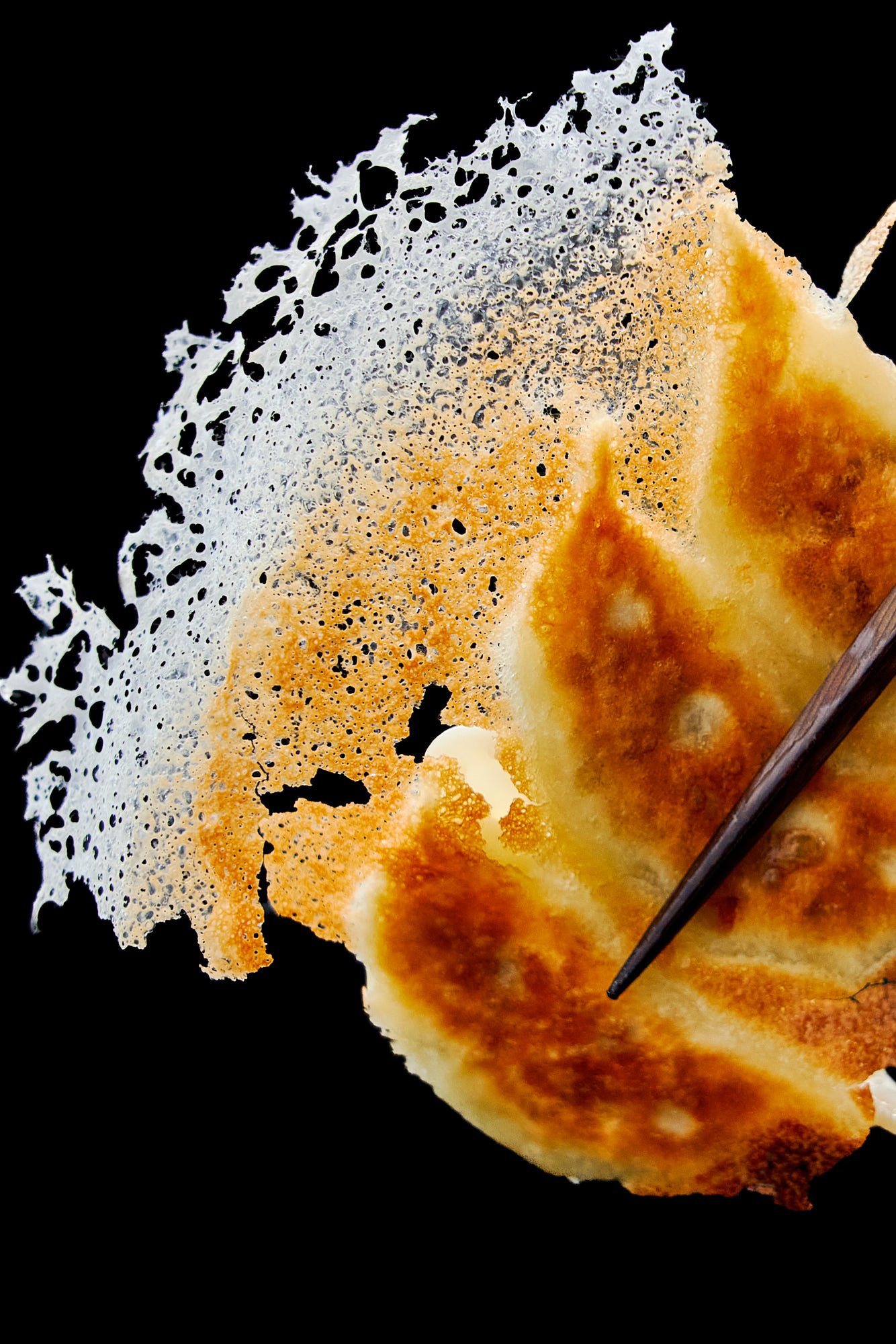
Hanetsuki Gyoza (羽根つき餃子 - literally “dumplings with wings”) is a culinary masterpiece that transforms ordinary cabbage dumplings into crispy works of food art. The contrast between the juicy filling, chewy gyoza wrapper, and that impossibly crispy skirt is a revelation.
I recently had the honor of learning this technique from its creator, Chef Isao Yagi of Nihao Honten . At 90 years old, Chef Yagi is still a force in the kitchen, and the opportunity to learn directly from the master was truly humbling. His innovative method involves steaming the potstickers in a flour and water batter which forms a thin, crispy skirt around the dumplings as the water evaporates. Since learning Chef Yagi’s method, I’ve been on a mission to perfect my crispy gyoza game, and I want to share my recipe to get restaurant-quality results at home.
I have a ton of potsticker recipes, whether you want a juicy pork and cabbage gyoza , a fragrant shiso one , a vegan gyoza recipe , or a modern cheesy dumpling . Then, you can follow this frying method to get crispy wings.
- Why My Recipe Works
- Ingredients
- How to Make Crispy Dumplings (Hanetsuki Gyoza)
- Serve it With
- 📖 Recipe
- FAQ
- Comments
Why My Recipe Works
- Getting the right consistency in the batter is crucial, and after learning the technique from Chef Yagi, I ran over 20 tests to find a ratio that makes the perfect crisp skirt for these dumplings.
- Using boiling water to gelatinize the starch in the flour prevents the slurry from settling.
- Adding a small amount of oil to the batter prevents the need to start with oil in the pan. It also helps to avoid boil-overs while steaming the dumplings.
- Waiting until all the liquid evaporates before adding oil ensures a smooth, crispy skirt without too many holes.
Ingredients
- Gyoza Dumplings - This recipe makes enough batter for about 30 uncooked gyoza. You can use your favorite dumpling recipe, or make a batch of my juicy pork and cabbage gyoza , which includes ground meat, cabbage, ginger, garlic chives, toasted sesame oil, and oyster sauce. Store-bought gyoza will work in a pinch.
- Flour - All-purpose flour forms the base of our crispy wing batter. It’s crucial for creating that delicate, lacy texture. I’ve tried using potato starch to make the wings in the past, but it doesn’t have the same texture as wheat flour.
- Water - A small amount of room-temperature water is mixed with the flour initially to prevent forming lumps in the slurry .
- Vegetable Oil - You’ll need a small amount of neutral-flavored oil (such as canola oil or sunflower oil) for the batter, and some additional oil to brown the crispy crust.
- Boiling Water - Boiling water gelatinizes (cooks) the batter, which prevents the flour from settling and ensures the crispy bottoms are thin and uniform.
How to Make Crispy Dumplings (Hanetsuki Gyoza)

To prepare the batter, start by combining the flour, room-temperature water, and oil until you have a smooth, lump-free mixture with the consistency of pancake batter. Then, add 1 ½ cups of boiling water to the flour mixture. This crucial step cooks the flour, preventing it from settling and ensuring an even, layer of crispy perfection. Use an immersion blender to emulsify the slurry until it resembles a thin gravy.
Heat a non-stick skillet over medium-high heat until it’s hot but not scorching. Pour ½ cup of the prepared batter into the pan, then quickly arrange 10 dumplings in two neat rows. Leave a little space between each dumpling-this allows the batter to spread and form the crispy crust.
Cover the pan with a lid, turn the stove to medium heat, and set a timer for 5 minutes. This allows the dumplings to steam. As the liquid evaporates from the batter, a crispy skirt begins to form on the bottom of the skillet. Keep an eye on the heat and adjust as needed-you want the liquid to be gently boiling but not so vigorously that it boils over.
After about 5 minutes, most of the liquid should have evaporated. Remove the lid and let any remaining water cook off. This step is crucial-the batter on the bottom of the pan must be dry and crisp before moving on. If it’s not, your gyoza wings will have holes in them.
Once the pan is dry, drizzle about a tablespoon of oil around the edges of the pan and over the potstickers. This extra oil helps the wings brown evenly. When the wings have reached a beautiful medium brown color, it’s time to serve.
Use a spatula to cut the sheet of gyoza with wings in half, separating the two rows. Plate your hanetsuki gyoza with the wing side up to maintain that satisfying crunch for as long as possible.
Serve it With

While these crispy gyoza are flavorful on their own, a basic dipping sauce of soy sauce, rice vinegar, and a dollop of my homemade chili oil can take them to the next level. Check out my gyoza dipping sauce recipes for more ideas.
These Japanese dumplings go great with vegetable side dishes like my smashed cucumber salad , grilled shishito peppers , or my spicy edamame . If you have leftover dumplings, try making my gyoza soup. To round out the meal, a bowl of sobameshi or shrimp fried rice is all you need to turn this into a complete meal.
📖 Recipe


Equipment
Units
Ingredients1x2x3x
- 30 gyoza (click link for my recipe)
- 20 grams flour (about 2 tablespoons)
- 2 tablespoons water
- 1 ½ teaspoons vegetable oil (plus more for frying)
- 1 ½ cups boiling water
Instructions
- Add 20 grams flour , 2 tablespoons water , and 1 ½ teaspoons vegetable oil to a beaker and mix until the batter is free of lumps.
- Add 1 ½ cups boiling water and use an immersion blender to emulsify the mixture until it is the consistency of a thin gravy. This can also be done in a blender or with a whisk.
- Heat a frying pan over medium-high heat until hot.
- Pour ½ cup of the batter into the pan and then line up 10 dumplings in two rows (use the 30 gyoza in 3 batches), leaving a little space between each one.
- Cover the pan with a lid and set a timer for 5 minutes to steam the gyoza. The liquid in the pan should be boiling, but not so much that it boils over, so adjust the heat as needed.
- When almost no liquid remains in the pan (~5 minutes), remove the lid and allow any remaining water to burn off. The batter on the bottom of the pan should be dry and crisp. This is very important, or your wings will end up full of holes.
- Drizzle about a tablespoon of oil around the edges of the pan, over the potstickers, and down the center between the two rows of dumplings. This helps the wings brown evenly.
- When the wings have reached a medium brown color, use a spatula to cut the sheet of potstickers in half.
- Serve the crispy gyoza with the wing side up to keep them crisp as long as possible. There is enough batter to make three batches of Hanetsuki Gyoza.
Nutrition Facts

Hanetsuki Gyoza means “gyoza with wings” in Japanese and is a cooking method that creates a crispy skirt of batter around each one. Chef Isao Yagi of Nihao Honten created the technique in Tokyo after immigrating from China to Japan in 1979. As for what’s inside, savory ground pork and cabbage are the most common filling ingredients, but these versatile dumplings can be filled with just about anything.
This is a 6-syllable name pronounced as follows (read the italicized parts). ha like ho nk ne like ne st tsu like ea t sou p ki like key gyo - the “g” is like " go " and the “yo” is pronounced like " yo yo" za like zo mbie
Yes, this will work with frozen gyoza (straight out of the freezer), just increase the amount of batter by 2 tablespoons and steam it for about 7 minutes instead of 5.
Yes, you can prepare the batter up to a day in advance and store it in the refrigerator. Give it a good whisk before using.
While best enjoyed fresh, you can store leftovers in an airtight container in the fridge. Reheat in a skillet with some oil to crisp them up again.

Hanetsuki Gyoza (Gyoza with Wings)
Equipment
- 1 Immersion Blender
- 1 Glass Beaker
- 1 10-inch Non-stick Frying Pan
- 1 10-inch glass lid
- 1 Turner (Spatula)
Ingredients
- 30 gyoza (click link for my recipe)
- 20 grams flour (about 2 tablespoons)
- 2 tablespoons water
- 1 ½ teaspoons vegetable oil (plus more for frying)
- 1 ½ cups boiling water
Instructions
- Add 20 grams flour , 2 tablespoons water , and 1 ½ teaspoons vegetable oil to a beaker and mix until the batter is free of lumps. 20 grams flour, 2 tablespoons water, 1 ½ teaspoons vegetable oil
- Add 1 ½ cups boiling water and use an immersion blender to emulsify the mixture until it is the consistency of a thin gravy. This can also be done in a blender or with a whisk. 1 ½ cups boiling water
- Heat a frying pan over medium-high heat until hot.
- Pour ½ cup of the batter into the pan and then line up 10 dumplings in two rows (use the 30 gyoza in 3 batches), leaving a little space between each one. 30 gyoza
- Cover the pan with a lid and set a timer for 5 minutes to steam the gyoza. The liquid in the pan should be boiling, but not so much that it boils over, so adjust the heat as needed.
- When almost no liquid remains in the pan (~5 minutes), remove the lid and allow any remaining water to burn off. The batter on the bottom of the pan should be dry and crisp. This is very important, or your wings will end up full of holes.
- Drizzle about a tablespoon of oil around the edges of the pan, over the potstickers, and down the center between the two rows of dumplings. This helps the wings brown evenly.
- When the wings have reached a medium brown color, use a spatula to cut the sheet of potstickers in half.
- Serve the crispy gyoza with the wing side up to keep them crisp as long as possible. There is enough batter to make three batches of Hanetsuki Gyoza.
