
Chaliapin Steak Don (シャリアピンステーキ丼)
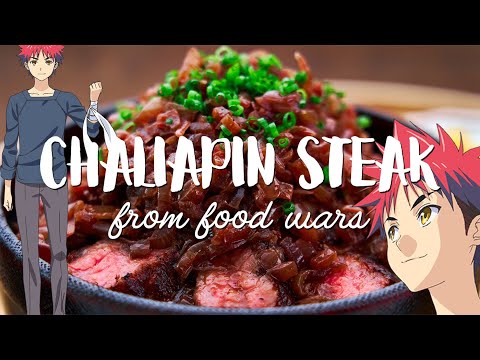
Although it has a Western-sounding name, Chaliapin Steak was created in Tokyo about 85 years ago. Since then, it’s become an overlooked staple of yōshoku (Western cuisine) in Japan. Recently, it’s come back into the spotlight thanks to a few episodes of Food Wars (食劇のソーマ Shokugeki No Soma), which prominently features it in an epic rice bowl battle between two chefs.
The battle of Chaliapin Steak Food Wars starts in episode 6 of season 1. The usually confident protagonist, Yukuhira Soma, hits the chef’s equivalent to writer’s block as he plans a dish for his first food battle. Inspired by some words of encouragement from a classmate, Soma starts to lay out the dish. In the next episode, he makes and presents his version of Chaliapin Steak in donburi form, and it’s a hit with the judges.
It’s entertaining, and some of the ideas introduced are brilliant, but if you tried to make a Chaliapin Steak Don in real life as presented on the show, it wouldn’t turn out the same way. I’ve gotten a lot of requests from supporters to do my take on some of the dishes featured in Food Wars, and this Chaliapin Steak recipe has been one of the most frequent requests.
- Chaliapin Steak Don (シャリアピンステーキ丼)
- Why My Recipe Works
- Ingredients for Chaliapin Steak Don
- How to Make Chaliapin Steak
- How to Make Ume Rice
- Other Donburi Recipes
- 📖 Recipe
- FAQ
- Comments
Why My Recipe Works
- Onions contain enzymes that help break down protein in the steak to render it nice and tender. To get the onions to release the enzymes, I salt the onions.
- Cutting slits into the steak allows the onion enzymes to penetrate more deeply into the steak while also physically tenderizing the meat by cutting through connective tissue.
- The chaliapin steak sauce is built on layers of flavors, starting with the browned meat juices from frying the steak, layering on browned onions, and then caramelizing some soy sauce. These flavors stick to the pan, so it gets “deglazed” with red wine to release the flavor into the sauce. Then the mixture is thickened by whisking in butter. This creates a rich, creamy sauce that’s delicately tangy and packed with umami from the meat juices and soy sauce.
- By serving this as a donburi over tangy ume rice, the dish becomes a delicate symphony of contrasting flavors, textures, and tastes that will make your mouth sing with delight.

Ingredients for Chaliapin Steak Don
- Steak - The onions the steak is marinated in helps tenderize the meat, but it’s not a miracle worker, so it’s still important to start with the best cut of meat that you can afford. If you want the most tender steak, I recommend using a cut from the tenderloin, but other cuts such as ribeye and NY strip work great and can have more flavor.
- Onions - Onions contain proteolytic enzymes, which break down protein. This has a tenderizing effect on meat, but the onion needs to be in contact with the meat for this to happen. Grating the onion is the best way to ensure you’re getting good meat/onion contact, but the onions are chopped in Soma’s Chaliapin Steak recipe. Since chopped onions won’t make good contact, it’s important to salt the onions. This “sweats” the onions, allowing some enzymes to coat the meat while seasoning it with salt.
- Soy Sauce - Although Chaliapin steak was envisioned as a Western dish, it was created in Japan by a Japanese chef, and the ingredients used in the chaliapin sauce recipe reflect this mixed heritage. Soy sauce not only seasons the dish it also provides a ton of umami. In Yukihira Soma’s version of the dish, he caramelizes the soy sauce, creating a toasty, nutty flavor that goes beautifully with the onions and butter.
- Red Wine - I suspect the onion sauce served with Chaliapin steak was inspired by Beurre Rouge (literally “red butter”), which is often served with steak. In this recipe, the wine provides the liquid to deglaze the pan of the meat juices and caramelized soy sauce. Then some butter gets emulsified in to create a decadent sauce.
- Butter - Soma fries his steak in butter in the show, but this is not a good idea. Steaks need to be seared at a high temperature, and using butter poses two issues. The first is that butter contains water which will cause the temperature in the pan to drop. The second is that butter contains milk solids that will burn and turn acrid by the time the steak is cooked. Butter basting is a thing, but in this case, the butter is added when the steak is almost cooked. For this recipe, I chose to add butter to the sauce instead. The milk proteins help the fat in the butter to combine with the other liquids, which creates an emulsion (similar to mayonnaise or hollandaise sauce). For the best flavor, I recommend using cultured butter.
- Rice - Chaliapin Steak is traditionally served with potatoes, but in Food Wars, Soma serves it atop a bowl of rice as a donburi or rice bowl.
- Umeboshi - Although there are a lot of technical inaccuracies in the Food Wars depiction of the preparation of this dish, adding umeboshi to the rice is genius. Umeboshi literally means “dried ume,” and it’s made by pickling ume (a fruit related to apricot) with salt and red shiso and then partially drying it. It is very tangy and salty. When minced and mixed with the rice, it seasons the rice while providing a refreshing foil that’s a great contrast to the rich steak and onions. Umeboshi comes in various levels of saltiness. I used a relatively low-sodium one that’s marked as “10%”. If your umeboshi is more salty you will need to reduce the amount you add to the rice.
How to Make Chaliapin Steak
To prepare the steak, you first want to mechanically tenderize it by cutting shallow slits into it at a 45-degree angle about a quarter-inch apart and about a third of the thickness of the steak deep. Then you can flip the steak over and repeat the same process at the same angle. This ensures the slits run perpendicular to each other on each side, so you don’t risk cutting all the way through the steak.
Mix the chopped onions with salt and then surround the top and bottom of the steak with the onions. (I share my favorite way to chop onions here .) Cover the container up and refrigerate it overnight to let the onion enzymes do their thing.
The next day, scrape off all of the onions from the steak and then season both sides of the meat with black pepper.
Heat a frying pan over medium-high heat until very hot, and then add the vegetable oil and steak. Let the steak form a nice brown crust on one side, and then flip it over and brown the other side. Depending on how thick your steak is, you may need to turn down the heat and flip the steak a few more times to cook it through to your desired doneness. A rare steak will have an internal temperature of 120-130 degrees F, a medium-rare steak will be 130-140 degrees F, and it goes up in 10-degree increments until you reach well done at 160 degrees F.
When the steak is done, transfer it to a plate and let it rest.
To prepare the sauce, turn down the heat and add the onions to the pan you cooked the steak in. Saute the onions until they’re tender but still retain their shape. This took me about six minutes.
Add the soy sauce to the onions and continue to saute as you stir until the liquid has evaporated and the soy sauce starts to caramelize to the pan.
Deglaze the pan with the red wine and let the mixture boil until the amount of liquid has reduced by about half.
Finish the sauce by vigorously whisking in the cold butter until the sauce is thick and creamy. Don’t overcook the sauce at this point, or the fat will separate out and make the onions greasy.
After the steak has had a chance to rest, slice it up as thinly as possible by holding the knife at a 45-degree angle to the cutting board.
How to Make Ume Rice
To make the ume rice, you first need to remove the pits from the umeboshi and then mince them into a paste.
Then you can fold the ume paste into the freshly cooked rice until it is evenly distributed.
To assemble the donburi, fill two rice bowls with the ume rice and then top each with half of the sliced steak. Next, split the onion sauce between the two bowls and then finish with a sprinkle of chopped scallions.

Other Donburi Recipes
- Chicken Katsudon Chicken Katsudon (cutlet bowl)
- Oyakodon (chicken and egg bowl)
- Gyudon (beef bowl)
- Tokachi Butadon (pork bowl)
📖 Recipe

Equipment
Units
Ingredients1x2x3x
For Chaliapin Steak
- 270 grams steak
- 350 grams onions (finely diced)
- ¼ teaspoon salt
- Black pepper
- 1 tablespoon vegetable oil
- 2 tablespoons soy sauce
- ⅓ cup red wine
- 2 tablespoons cultured unsalted butter
To serve
- 2 servings Japanese short grain rice (2 rice cooker cups cooked in rice cooker)
- 70 grams umeboshi (10% sodium, pitted and minced)
- Scallions (chopped for garnish)
Instructions
- Cut slits ⅓ of the way into the 270 grams steak ¼-inch apart. Flip the steak over and repeat, holding the knife at the same angle.
- Mix the 350 grams onions and ¼ teaspoon salt and surround the steak in onions. Cover and marinate in the fridge overnight.
- When the steak is done marinating, brush off all of the onions from the meat and set the onions aside. Season both sides of the steak with Black pepper .
- Preheat a frying pan over medium-high heat until very hot. Add the 1 tablespoon vegetable oil and then add the steak.
- Fry on one side until nicely browned, and then flip and fry the other side.
- When the steak is cooked to your liking, transfer it to a plate and let it rest while you prepare the onions.
- Turn down the heat and add the onions. Stir-fry these until they’ve started to brown around the edges, but they still hold their shape (about 6 minutes).
- Add the 2 tablespoons soy sauce and continue stir-frying until the liquid has evaporated and the soy sauce starts to smell toasty.
- Add the ⅓ cup red wine and boil until it no longer smells like alcohol.
- To finish the sauce, add the 2 tablespoons cultured unsalted butter and vigorously whisk it in to thicken the sauce.
- For the rice, fold the minced 70 grams umeboshi into the 2 servings Japanese short grain rice until evenly distributed.
- Fill two bowls with the ume rice, and then top with the sliced steak. Finish each bowl with a mound of onions, and garnish with some chopped Scallions .
Nutrition Facts
Chaliapin Steak was invented by Tsutsui Fukuo in 1936. He was the head chef at New Grill in the Imperial Hotel when Russian opera singer Feodor Chaliapin came in requesting a soft steak. Utilizing mechanical and enzymatic tenderization techniques, Chef Tsutsui created a dish that was an instant hit and named it after his famous guest. Although Chaliapin Steak has become a staple of Western-style yōshoku cuisine in Japan, it wasn’t very well known abroad until it was featured in a few episodes of Food Wars.
“Don” is an abbreviation for donburi, which refers to a large rice bowl in Japanese. It’s also the name given to a class of dishes with a savory topping served over a large bowl of rice. Chaliapin Steak Don is a modern preparation of the classic Japanese steak popularized by the anime series Food Wars. Yukihira Soma’s version from the show is made by marinating steak with onions to tenderize it. The steak is then pan-fried, and the onions get cooked in the same pan after the steak is done. He then makes a sauce using soy sauce and red wine before serving the steak and onions over a bed of ume rice. This uses similar ingredients to Japanese Roast Beef Don , but the method for preparing the meat and the sauce is different, resulting in a unique dish.
Chaliapin Steak Don is an 8 syllable phrase that is pronounced as follows in Japanese: sha like sha rk ri the " ri " sound does not exist in the English language, and the best way to make it is to say the word " rea m" with the tip of your tongue at the front of your mouth. a like aa rdvark pin like pen al su like sou p te- like te n with an elongated ’e’ ki like ke y don like don ut

Chaliapin Steak Don
Equipment
- 1 breading tray
- 1 10-inch Non-stick Frying Pan
- 1 Spatula
- 1 Tongs
Ingredients
For Chaliapin Steak
- 270 grams steak
- 350 grams onions (finely diced)
- ¼ teaspoon salt
- Black pepper
- 1 tablespoon vegetable oil
- 2 tablespoons soy sauce
- ⅓ cup red wine
- 2 tablespoons cultured unsalted butter
To serve
- 2 servings Japanese short grain rice (2 rice cooker cups cooked in rice cooker)
- 70 grams umeboshi (10% sodium, pitted and minced)
- Scallions (chopped for garnish)
Instructions
- Cut slits ⅓ of the way into the 270 grams steak ¼-inch apart. Flip the steak over and repeat, holding the knife at the same angle. 270 grams steak
- Mix the 350 grams onions and ¼ teaspoon salt and surround the steak in onions. Cover and marinate in the fridge overnight. 350 grams onions, ¼ teaspoon salt
- When the steak is done marinating, brush off all of the onions from the meat and set the onions aside. Season both sides of the steak with Black pepper . Black pepper
- Preheat a frying pan over medium-high heat until very hot. Add the 1 tablespoon vegetable oil and then add the steak. 1 tablespoon vegetable oil
- Fry on one side until nicely browned, and then flip and fry the other side.
- When the steak is cooked to your liking, transfer it to a plate and let it rest while you prepare the onions.
- Turn down the heat and add the onions. Stir-fry these until they’ve started to brown around the edges, but they still hold their shape (about 6 minutes).
- Add the 2 tablespoons soy sauce and continue stir-frying until the liquid has evaporated and the soy sauce starts to smell toasty. 2 tablespoons soy sauce
- Add the ⅓ cup red wine and boil until it no longer smells like alcohol. ⅓ cup red wine
- To finish the sauce, add the 2 tablespoons cultured unsalted butter and vigorously whisk it in to thicken the sauce. 2 tablespoons cultured unsalted butter
- For the rice, fold the minced 70 grams umeboshi into the 2 servings Japanese short grain rice until evenly distributed. 2 servings Japanese short grain rice, 70 grams umeboshi
- Fill two bowls with the ume rice, and then top with the sliced steak. Finish each bowl with a mound of onions, and garnish with some chopped Scallions . Scallions
